When a Client Disputes Your Invoice


Part 6 of 10 in the Event Planner's Financial Survival Guide
You probably remember the first time it happened. A client — maybe a good one, someone you liked working with — pushed back on your invoice. Not a gentle clarifying question, but a real dispute. "This doesn't look right." "We didn't authorize this." "I don't see why we're being charged for that." It's a gut-punch feeling even when you know you're in the right. And the worst part is that being in the right doesn't automatically resolve it. What resolves it is documentation.
Why Disputes Happen
Invoice disputes between clients and event planners usually fall into a few categories, and most of them are preventable. Scope creep that wasn't formalized. The client asked for small changes along the way — an extra hour of photographer coverage, an upgraded linen package, a second AV technician for the breakout rooms. Each of these was approved verbally or over email, the event happened, and you billed for them. But by invoice time, the client has mentally filed those decisions as "minor adjustments" and is surprised to see them as line items with real dollar amounts attached. Budget conversations that didn't happen often enough. When clients aren't getting regular budget updates during the planning process, the final invoice can feel like a surprise even when everything on it was discussed and agreed upon at some point. The invoice arrives and it's higher than what they were vaguely expecting, and the gap between expectation and reality becomes a dispute. Unclear invoices. As we discussed in an earlier post, vague line items invite scrutiny. If your invoice says "Additional Services: $2,400" and the client doesn't know exactly what that covers, they're going to ask — and if the answer isn't immediately satisfying, the conversation escalates. Genuine errors. Sometimes the invoice is actually wrong. A line item that should have been removed, a charge for something that didn't happen, a math error. These are rare when your system is organized and common when it isn't.
Your Records Are Your Defense
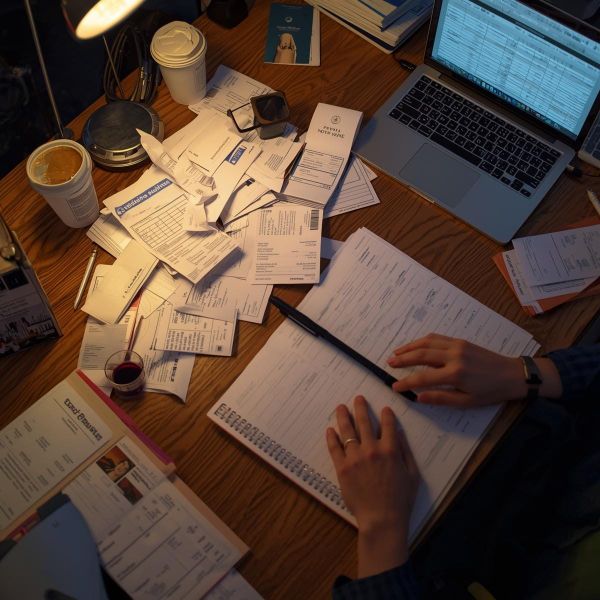
Here's the thing about invoice disputes: they're almost always resolved by whoever has better records. If you have a detailed, timestamped record of every budget change, every scope addition, every approval — and your invoice lines up precisely with those records — a dispute resolves quickly. You can walk the client through exactly what was approved, when, and by whom. That kind of clarity either answers their question immediately or makes clear that the burden of proof is on them to show otherwise. If your records are a mix of email threads, verbal conversations you remember but can't document, and a spreadsheet that's been through fifteen versions — a dispute is a much harder conversation. You know you're right. You just can't prove it cleanly. And the negotiation begins.
The Change Order Habit
One of the most protective habits an event planner can develop is formalizing scope changes as they happen, not after the fact. Any time a client requests something that isn't in the original agreement — additional services, upgrades, extended coverage, anything that has a cost implication — that change should be documented and acknowledged before the event. Not necessarily a formal contract amendment every time, but at minimum a written confirmation: "Just to confirm, we're adding two additional hours of photography coverage at $X, bringing our revised total to $Y. Please reply to confirm." That email, sent and received, is your invoice documentation. When the client sees that line item on the final bill, you have a paper trail that connects it to a specific approved change at a specific amount. The discipline to do this consistently is hard to maintain in the middle of event production, when things are moving fast and clients are making requests casually. But the planners who build this habit report dramatically fewer disputes — and when disputes do arise, they resolve much faster.
Budget Transparency Throughout the Process
The other major dispute preventer is keeping clients informed about budget status during the planning process, not just at the beginning and end. When a client has been seeing budget updates all along — here's where we are after the venue deposit, here's the impact of the AV upgrade you requested, here's our revised total heading into the final production phase — the final invoice isn't a surprise. It's a confirmation of a number they've been watching develop. This kind of ongoing transparency requires that your budget is always current and that generating a client-facing summary is easy enough that you actually do it regularly. If pulling together a budget update is a thirty-minute project, you'll do it infrequently. If it takes two minutes, you'll do it often.
When You Do Need to Negotiate
Sometimes, despite everything, a client pushes back on something that's legitimately a judgment call — a charge that you can defend but that they reasonably didn't expect. These situations call for a different approach than pure documentation. The instinct is to stand firm. And sometimes that's right. But sometimes the better business decision is to absorb a small charge to preserve a valuable relationship and a clean reputation. The calculation is yours to make — but it's a much easier calculation when the rest of your invoice is airtight and the dispute is about one specific item rather than a general sense of unease about the whole bill. Clear, detailed, well-documented invoices give you the credibility to have that conversation from a position of strength, even when you're willing to be flexible. In the next post, we're going to zoom out a little and talk about the moment every planner both dreads and needs: closing the books after the event is over.
Next up: The Post-Event Financial Scramble →
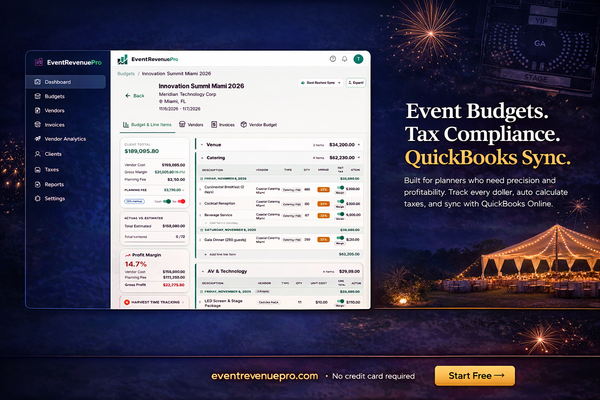
Event Revenue Pro was built to solve exactly this — a purpose-built financial platform for event planners, DMCs, and event agencies. Learn more →