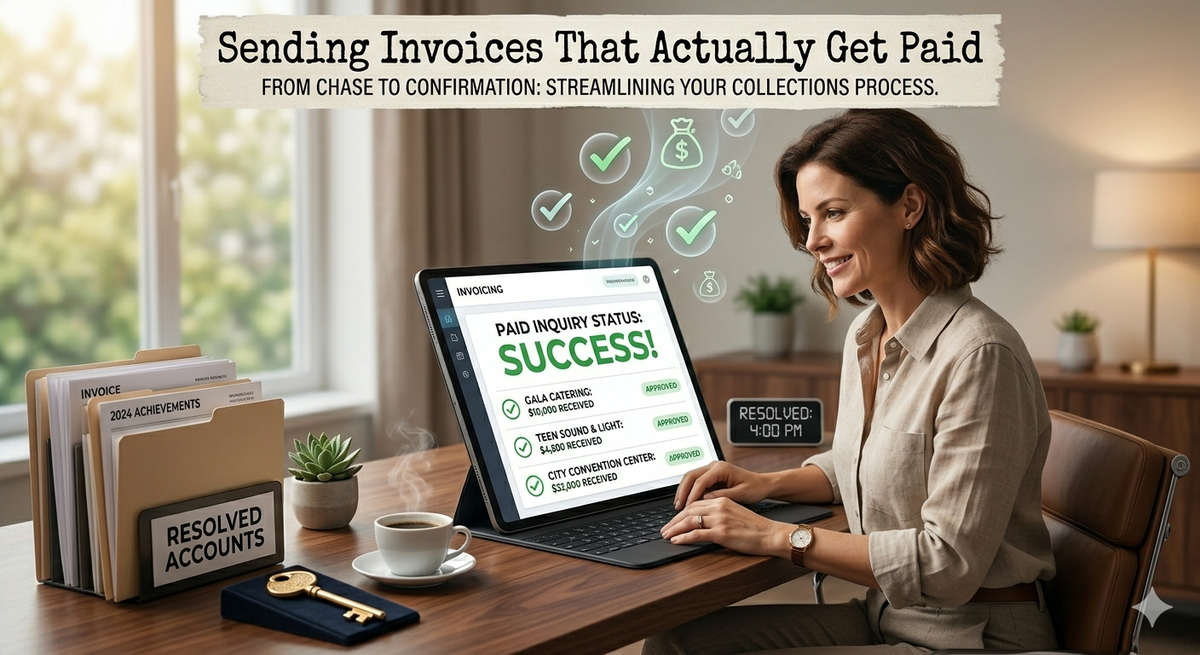
Sending Invoices That Actually Get Paid

Part 4 of 10 in the Event Planner's Financial Survival Guide
You've done the work. The event was beautiful. The client is thrilled. You send the invoice — and then you wait. A week passes. Then two. You send a gentle follow-up. You get a "sorry, I'll get to it this week." Another week passes. You send another follow-up, this time a little less gentle. The client responds with a question about a line item, and now you're in an email thread explaining your charges while the clock ticks on a balance that should have been settled weeks ago. Late payments are one of the most frustrating parts of running an event planning business, and the irony is that many of them have nothing to do with clients who don't want to pay. They have everything to do with invoices that make it too easy to delay.
The Invoice That Invites Questions
An invoice that's unclear is an invoice that gets scrutinized. When a client receives a document with vague line items — "Event Services: $12,500" or "Vendor Costs: $8,200" — they don't feel confident approving it. They have questions. And questions create delay. The best invoices tell a story. They show the client what they're paying for, organized in a way that matches how they experienced the event. Venue fee, catering, florals, AV, transportation — each with a clear description, quantity where applicable, and price. When a client can look at your invoice and immediately understand what each line represents, the path to approval is short. That sounds obvious, but generating a detailed, organized invoice from a spreadsheet-based system is genuinely tedious — which is why many planners default to summary-level line items that are easier to produce but harder for clients to process.
Timing Matters More Than You Think
Here's something planners underestimate: the invoice sent the day after the event gets paid faster than the invoice sent two weeks later. Not always, but consistently. The reason is psychological. The day after the event, your client is still in the glow of it. The flowers were gorgeous, the food was great, the speeches went smoothly, and you made it all happen. Their relationship with you is warm and positive. An invoice in that moment feels like a natural close to a great experience. Two weeks later, they've moved on. The event is a memory. The invoice arrives in the context of their current work week, their current budget pressures, their current pile of things to deal with. It's not that they don't want to pay you — it's that it's no longer top of mind, and it's easier to defer. Invoicing quickly is one of the simplest things you can do to improve your cash flow. But it requires having a system where creating the invoice doesn't require starting from scratch.
Deposits, Installments, and the Final Balance
Most event planning engagements involve multiple payments: a deposit at signing, sometimes a mid-production installment, and a final balance after the event. This is standard practice and it's good for cash flow — but it requires careful tracking. The confusion we hear about most often: what counts toward the final balance? When the final invoice goes out, the client should be able to see clearly: the total event cost, the payments already made, and the remaining balance due. If your deposit was recorded in one place and your final invoice is built in another, reconciling those two numbers is manual work — and errors create awkward conversations. "I thought my deposit was applied." "Why does this say I owe the full amount?" "This doesn't match what we agreed." These are questions that shouldn't have to happen. When your deposit tracking and your invoicing are connected, the final invoice is automatically accurate — total due, payments received, balance remaining. Clean, professional, no ambiguity.
The Payment Method Question
One small thing that generates a surprising amount of friction: not making it clear how you want to be paid. "Check, ACH, Zelle, wire — whatever works for you" sounds flexible, but it often results in clients not doing anything because they're not sure which option you actually prefer or what your payment details are. Specify your preferred method clearly on the invoice, with the information they need to act immediately. Removing friction from the payment process is worth more than it sounds. Every additional step between "I should pay this" and "I just paid this" is an opportunity for the payment to be deferred until later.
What Professional Invoicing Looks Like
The invoices that get paid fastest are the ones that are detailed without being overwhelming, clear about what's owed and when, specific about how to pay, and sent while the relationship with the client is still warm. They're generated directly from your budget, so every line item is accurate and nothing is missing. They show payment history clearly — deposits applied, balance due. They go out quickly because the system does the heavy lifting. And when a client does ask a question — which they will — you can answer it in one look because your budget and your invoice are the same document viewed from different angles, not two separate sources that you have to reconcile before you can respond. Coming up next: the topic that comes up every time we talk to planners who do multi-state events or work with clients in different jurisdictions. It's dense, it's genuinely complicated, and ignoring it is a financial risk that too many planners take without realizing it.
Next up: Sales Tax for Event Planners Is a Nightmare →
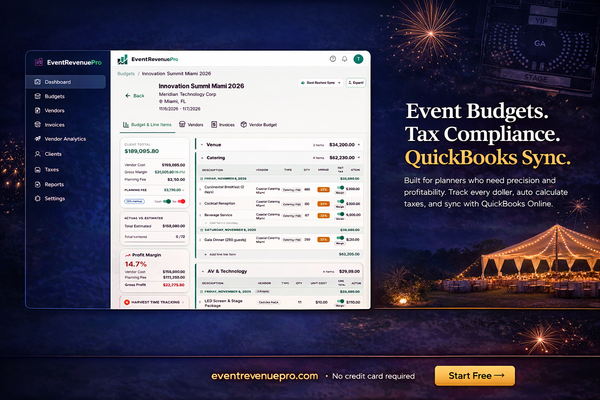
Event Revenue Pro was built to solve exactly this — a purpose-built financial platform for event planners, DMCs, and event agencies. Learn more →